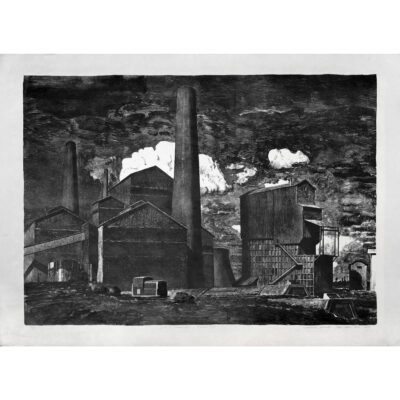

Braque, Georges, Varengeville, 1956
1956
Interpretative color etching on Rives paper
38.3 x 74.9 cm
Numbered in pencil lower left on 300, signed by the artist in pencil lower right
Engraving and print by Crommelynck et Dutrou; Maeght éditeur, Paris
Catalog raisonné: Vallier p. 294; Maeght 1023
Varengeville, a village in Normandy not far from Dieppe, saw the arrival of artist Georges Braque and his wife Marcelle in 1928. They fell under its spell and soon bought a plot of land on which to build a traditional farmhouse. The area was ideal for walks and the search for the materials he would use in his canvases: chalk taken from the cliff face, sand, sawdust – all elements that would add substance to his canvases. This 1952 painting is reproduced in etching by the master engravers at Atelier Crommelynck. The background is horizontal, with the sky and ocean overhung by a cliff, and white chalk visible in the foreground. The colors are those of Normandy on a rainy day.
About the author
Georges Braque (1882-1963)
The creator of Cubism with Pablo Picasso around 1907, after the First World War he adopted a more traditional aesthetic with a fairly dark color palette. Still lifes and landscapes are bathed in a calm, silent atmosphere. Georges Braque was also a painter of birds, which figured prominently in his late work. In 1953, they were given pride of place on the ceiling of the Salle Henri II at the Louvre. A close friend of poets such as René Char, Francis Ponge and Pierre Reverdy, Georges Braque illustrated numerous texts.