
The Mountain and the Fly
Cabinetmaker Francis Ballu was awarded first prize in the “meilleurs ouvriers de France” competition in 1979. Versatile, he is also a sculptor, engraver and poet. In 1980, with architect Rémi Colmet Daâge and cabinetmaker Martin Spreng, he founded the Xylos group. In 1998, Xylos joined the prestigious Grands Ateliers de France association. The group quickly established a solid reputation, winning numerous public and private commissions.
The approach of these passionate designers is in the tradition of the Arts & Crafts movement, created in England in the mid-19th century by William Morris, who, at a time when industrialization was in full swing, defended the alliance of the beautiful and the useful, traditional skills and above all their involvement in the creation of furniture and everyday objects. The Xylos Group’s creations similarly blend art and life.
It’s the functional, furniture-like sculptures that interest Francis Ballu in the group. They are always enigmatic: La Boule (1998) can be used as a bar or a cigar cellar, the sails of boats in regattas (2006) can be used as benches in the Chemin de l’Ile garden, the Totems-sièges(1996), and so on. They have an unexpected, magical and unusual character, due to their secret nature. Indeed, some of them give no hint of their function: the almost cubist abstract sculpture Le Poids de l’écriture (2003), for example, reveals its identity as a writing table.
Their creations are sophisticated and well thought-out. They are designed with wood species and innovative technologies. What interests them most is combining different materials. They work mainly with wood and resin, to which they give the appearance of stone. The illusion of materials is characteristic of their work. The works are deeply rooted in a dialogue with nature that revolves around the link between the mineral and the vegetable.
After working together for some thirty years, the paths of the protagonists of the Xylos group are parting. Francis Ballu continues his creative activity in the continuity of the issues that have always been his, which are in a way his DNA. While he is increasingly interested in “pure” sculpture, he remains fundamentally passionate about the functional dimension of sculpture. Today, he works with Julien Tillie, his right-hand man, and Etienne de Saint Exupéry – a remarkable mechanic – who collaborates on the mechanical aspects of the movements. For the past ten years or so, Francis Ballu has been creating sculptures, called Gmites, which support the branches of the weeping blue cedar, the jewel in the crown of the arboretum in the Vallée-aux-Loups departmental park in the Hauts-de-Seine department. The work develops and grows with the rhythm of nature. The sculptures are living elements in symbiosis with the tree. They are one with it.
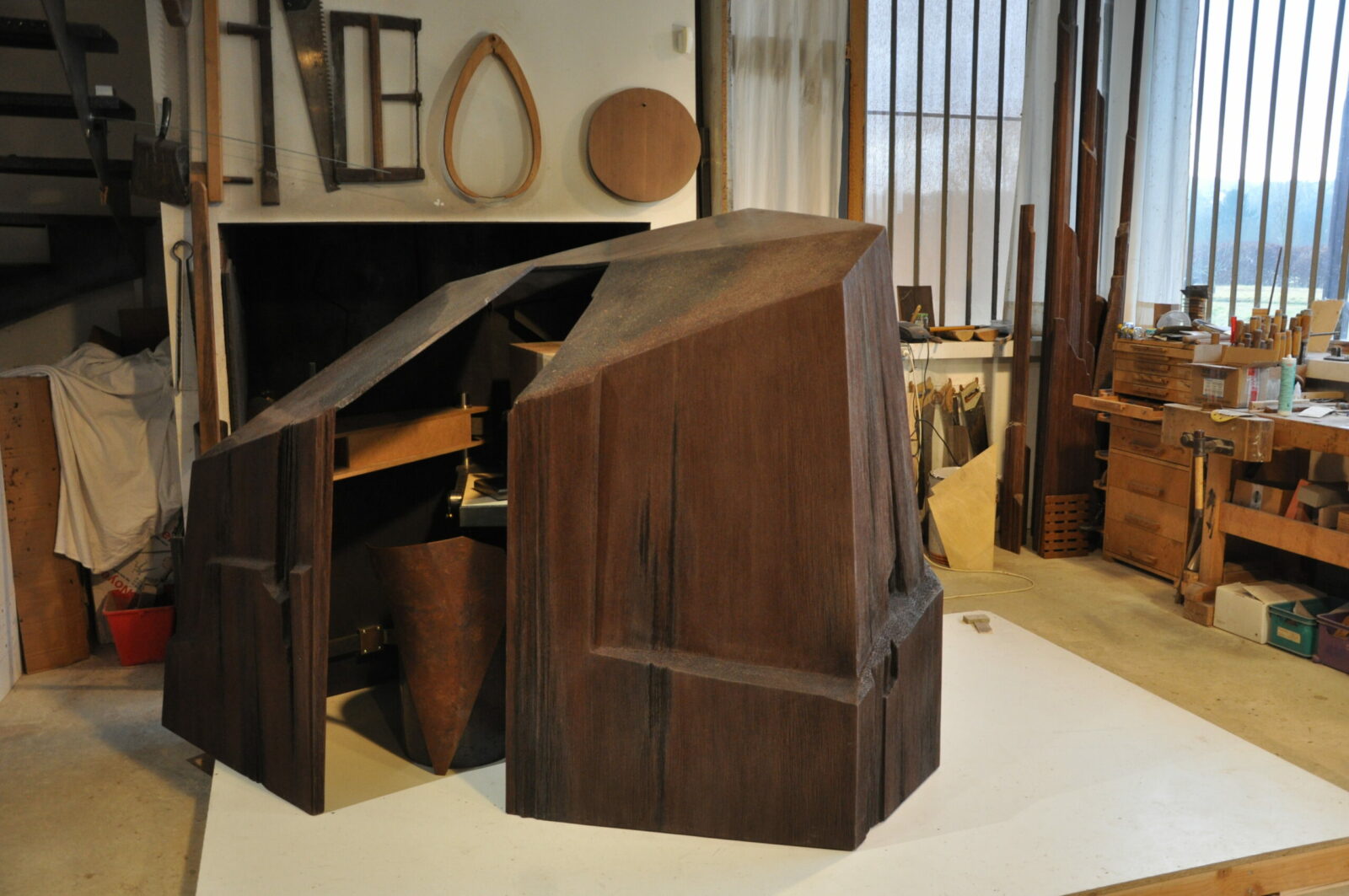
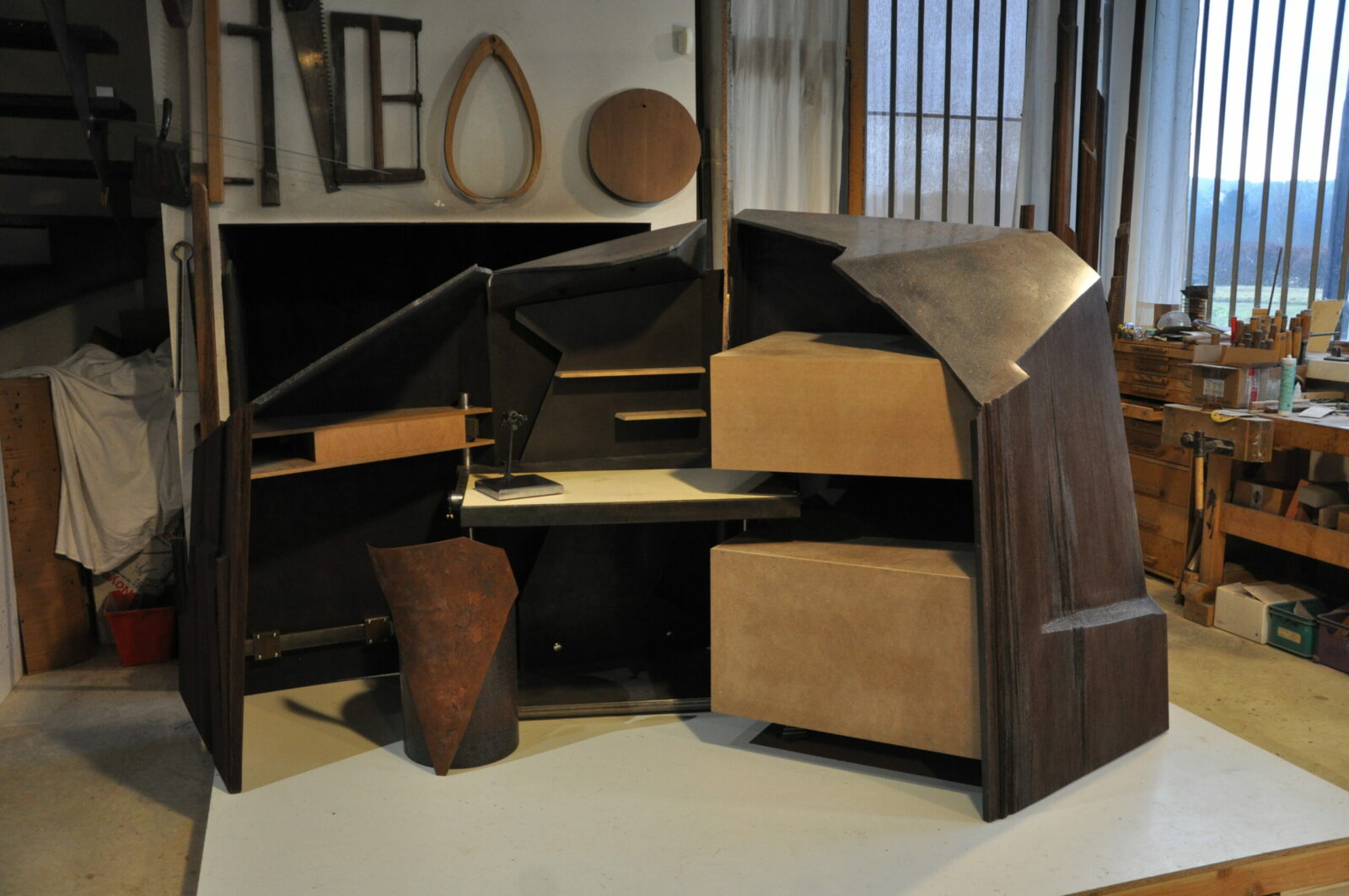
From June 3, the Galerie de l’Institut presents an exhibition devoted to his latest creation, entitled La Montagne et la Mouche (The Mountain and the Fly ), a binary title that aptly sums up his research. The work is a sculpture. It evokes a mountain. The sculpture opens up to reveal its share of mystery, surprise and the unusual. It unfolds a workshop for making fishing flies, consisting of a workbench, a vice and a set of drawers for storing the materials needed to make these baits. This extraordinary enthusiast’s creation features mineral and petrified mineral effects that testify to a great sensitivity to materials. La Montagne et la Mouche is accompanied in the exhibition by a large wall decoration, on the theme of glaciation, whose functionality is to be discovered, entitled Le Glacier.
Anne Coron, in collaboration with Francis Ballu