
JEAN LURÇAT
(1892-1966)
A native of the Vosges region, Jean Lurçat studied under Victor Prouvé at the École Nancy, founded in 1901 by Émile Gallé, who advocated the meeting of art and industry, art and decoration. He moved to Paris in 1912, at the height of the Cubist movement. After a brief spell at the École des Beaux-Arts, he entered the Académie Colarossi. Trained as a painter, but strongly influenced by decorative practices, Lurçat soon tried his hand at tapestry. In 1917, his mother commissioned his first canvas-stitch tapestries , Filles vertes and Soirée dans Grenade. After the war, he traveled to Switzerland, Germany and Italy. He exhibits in Zurich, Geneva, Berne and Paris at the Salon des Indépendants (2 tapestries and 4 canvases). Lurçat settles in Paris with his future wife Marthe Hennebert. She creates his two tapestries, Pêcheur and Piscine, in petit point.
In the 1920s, his painting was marked by Cubism and Surrealism. His work took on dreamlike overtones, especially his landscape paintings, imbued with melancholy and solitude, such as Surrealist Landscape of 1928 (private collection), reminiscent of Arnold Böcklin. Early in the decade, he met Pierre Chareau, designer of the famous glass house for his friends Jean and Annie Dalsace, with whom he collaborated on furniture ensembles, carpets and wallpapers. He created his first tapestry for Marie Cuttoli, Le Cirque, in 1922. Through her commissions for avant-garde artists, Marie Cuttoli was, in the private sphere, the great initiator of the tapestry revival in France. Georges Braque, Henri Matisse and Pablo Picasso took up the challenge at a time when the boundaries between the arts were becoming increasingly blurred. Throughout the

Surrealist Landscape, 1939, Oil on canvas, 129 x 195 cm ©ADAGP, Paris, 2024.
Lurçat continues to travel. He visited Spain, North Africa, Greece and Asia Minor (now Turkey). In 1924, he marries Marthe Hennebert, who creates his canvases. He signs a non-exclusive contract with Etienne Bignou. Jeanne Bucher presented his work on several occasions in her gallery on rue du Cherche-Midi. He takes part in the set design (carpets and paintings) for Marcel L’Herbier’s film
He stayed and worked in New York several times, in 1928, 1933 and 1934. In 1933, he designed the set and costumes for Jardin public, a ballet by Georges Balanchine with music by Vladimir Dukelsky, an opportunity for Lurçat to diversify his involvement in decoration. He collaborated with the choreographer again the following year for the ballet
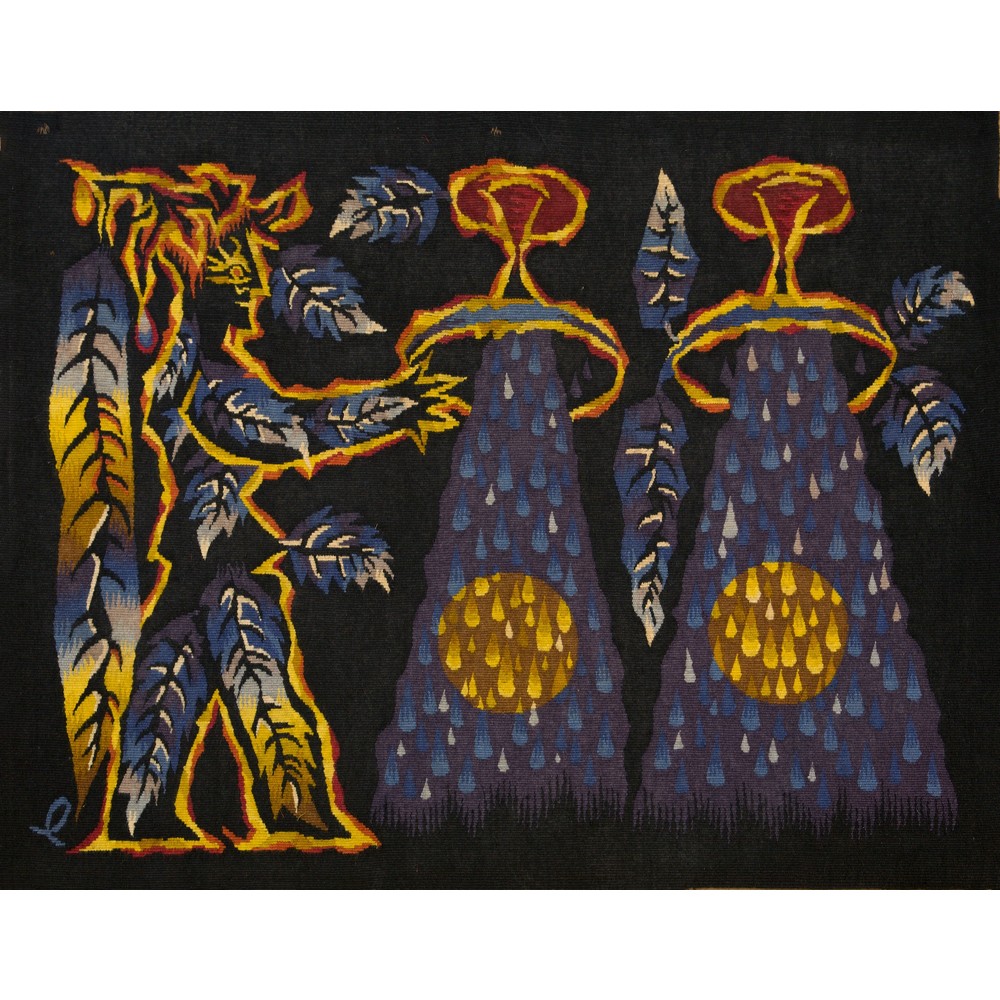
Verseau, 1959, Tapestry, 63 x 51 cm ©ADAGP, Paris, 2024.
In 1936, he had his first tapestry, Les Illusions d’Icare, woven at the Manufacture nationale des Gobelins. The tapestry was presented by the French State to the Queen of Holland. On this occasion, Lurçat made the acquaintance of lissier François Tabard. Coming from a long line of tapestry-makers, François Tabard and his three siblings ran the family workshop in Aubusson. He was also active on a more global level, as president of the fledgling Chambre syndicale des fabricants de tapisserie and of the Guéret Chamber of Commerce. At the time of his meeting with Lurçat, Aubusson, with its centuries-old tapestry-making tradition established as a Manufacture Royale by Colbert in the 17th century, was aware of the need to renew its production through the search for new models.
Lurçat travels to Spain, a country in the grip of nationalism. His painting is tinged with dramatic accents in which historical events resonate. The Spanish War, the Guernica massacre relayed by Pablo Picasso’s painting, the rise of nationalism throughout Europe, the threat of disaster – all these haunt Lurçat’s paintings. He painted desolate, tragic, burning landscapes. These were his last oil paintings, from then on preferring gouache. In 1937, he took part in the decorations for the Exposition internationale des arts et des techniques appliqués à la vie moderne.
The following year, Lurçat discovered the 14th-centuryApocalypse tapestry in Angers (Domaine national du château d’Angers). Tapestry became an increasingly important part of his practice. He appropriated the technique of tapisserie de lisse and sought to revive the simplicity of medieval tapestries. He developed the numbered cardboard (colors are no longer painted, but numbered) and opted for a reduced palette. The Moisson tapestry, woven by the Tabard workshop, inaugurates this new method. In 1939, along with Marcel Gromaire and Pierre Dubreuil of the French Ministry of Education, he was commissioned by Guillaume Janneau, director of the Manufactures nationales de Beauvais et des Gobelins, to halt the decline in the art of tapestry. They moved to Aubusson in the summer of 1939. Lurçat composes the great Four Seasons wall hanging, a traditional tapestry theme. Lurçat creates a poetic world inspired by medieval imagery, Picasso and surrealism. Iconographically, he develops a universe very close to nature and the elements. The sun, foliage, birds and a whole bestiary are omnipresent. The rooster occupies a privileged place among the motifs that inhabit his work.

Le Chant du Monde by Jean Lurçat in the former ward of the Hôpital Saint-Jean
Musées d’Angers, F. Baglin; Fondation Lurçat / Adagp, Paris 2021
At the height of the war, in August 1941, he moved to the Lot region. He took part in the communist resistance movement with Jean Cassou, René Huyghe and Tristan Tzara. In 1942, the tapestries Liberté, based on a poem by Paul Éluard, and Es La Verdad, based on a poem by Guillaume Apollinaire, were woven in Aubusson. He joins the Communist Party. At the Liberation, he and other artists founded the Association des Peintres-Cartonniers de Tapisserie (APCT), of which he was appointed president. In the summer of 1946, a major exhibition entitled La Tapisserie française du Moyen Age à nos jours (French tapestry from the Middle Ages to the present day) was held at the Musée National d’Art Moderne in Paris. An entire room was devoted to Jean Lurçat’s tapestries. As Jean Cassou points out in the catalog, “we can and must speak of a renaissance of French tapestry. This event revives the whole history of a national art, with its contrasts, its opposing intentions and meanings, its counterpoints, all its moving richness.” The exhibition was then presented in Amsterdam, followed by Brussels and London in 1947. In the summer of 1949, Jean Cassou organized another exhibition on tapestry at the Musée National d’Art Moderne, highlighting the dynamism of national manufacturers in the post-war revival of tapestry. Four years of French tapestry. Manufactures nationales and Mobilier national .
Like many other modern artists commissioned by Père Couturier in the context of the revival of religious art, Lurçat takes part in the decoration of the Notre-Dame-de-Toute-Grâce church on the Plateau d’Assy. He composed the tapestry l’Apocalypse for the church choir. Lurçat also produced illustrated books. In 1949-1950, he illustrated André Richaud’s La Création du monde and Jean-Henri Fabre’s Le Monde merveilleux des insectes with color lithographs, as well as an anthology of twenty Fables by Jean de La Fontaine. Chagall’s illustration of the Fables appeared shortly afterwards, in 1952, published by Tériade. The post-war period was extremely prosperous for illustrated books.
In the 1950s, Lurçat gave numerous lectures around the world, in Europe, the United States, South America and China. While Picasso had been living in Vallauris since 1948 and continued his passion for the arts of fire, Jean Lurçat produced his first ceramics at the Sant-Vicens pottery, founded by Firmin Baudy, in Perpignan in 1951. Other artists who contributed to the revival of French tapestry alongside Lurçat, such as Jean Picart Le Doux and Marc Saint-Saëns, also frequented the Sant-Vicens workshop. In 1954, he created a major tapestry,
A major retrospective celebrates Lurçat’s work in 1958 at the Musée National d’Art Moderne. In 1961, on the initiative of Lurçat and Pierre Pauli, the Centre International de la Tapisserie Ancienne et Moderne (CITAM) was created in Lausanne. Lurçat was elected president.
He died on January 6, 1966 in Saint-Paul-de-Vence.